The History of the School District
of Hillsborough County, Florida
1839 The U.S. Congress passed an act that designated “the sixteenth section of each township” for the purposes of public education. The legislation was known as the “territorial school laws”, but no federal mandates were provided to actually establish schools. The law also did not provide any specific provisions for states to follow.
At this time, there were very few “public” schools located anywhere in Florida. There are unofficial reports of the first public school in Florida being founded in Key West in 1834. Prior to 1850, Monroe and Franklin were the only two counties in Florida that were reported to have true public schools. (30)
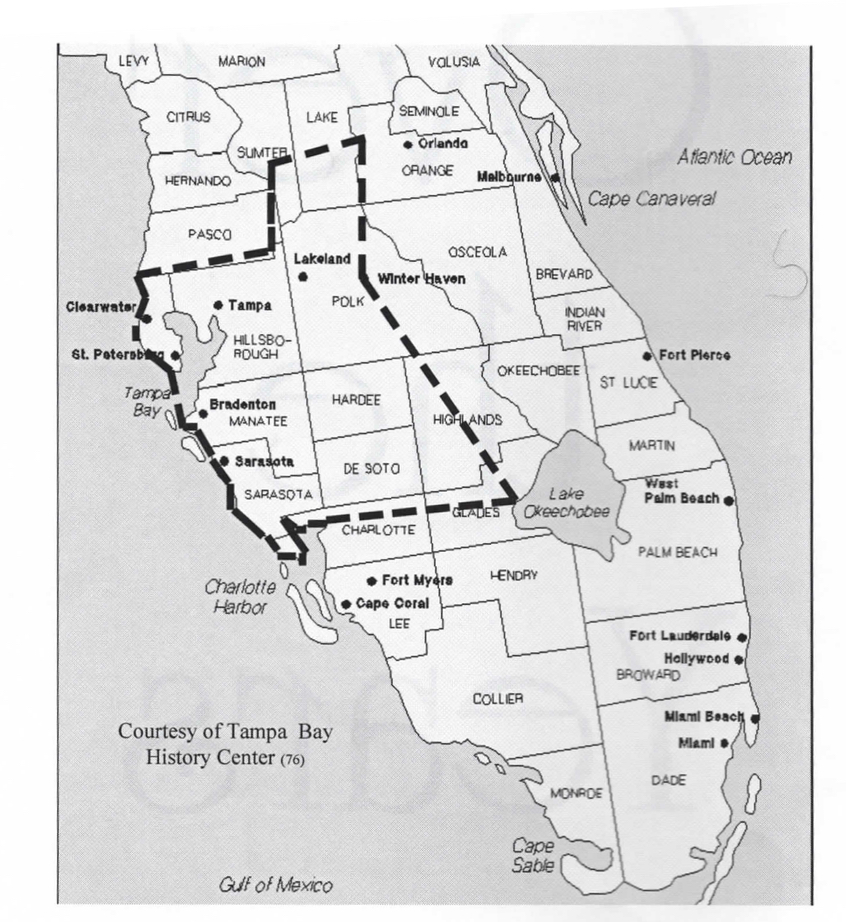
During the mid 1800’s, as seen in the map below, Hillsborough County covered a vast geographical area including all, or parts of present-day Pinellas, Polk, Pasco, Manatee, Hardee, DeSoto, Highlands, Glades, Sumter, Lake, Charlotte, and Sarasota counties. In total area, within the broken lines, the district was approximately four times the size that it is today. Despite this huge area, there were less than 1,000 residents with the majority living in the “ village” of Tampa. Census records from 1845 cite a total population of 836 residents including 364 black enslaved persons scattered throughout the county. (I) Due to this, there was minimal need for public education at this time. Parents with sufficient means sent their children to boarding schools in states north of Florida.
This section chronicles the Hillsborough County School District’s development by year.
1848
BANNER
The first written record of education held in a “public facility” was Wilson’s school in the County Courthouse in 1848.W.P. Wilson operated a school program that was funded entirely by tuition fees. In this sense, it was private. However, the County Commissioners allowed Wilson to use the courthouse free of charge, which constitutes the first use of publicresources for educational purposes. Based on this, it may be considered as the first “public school” provided in Hillsborough County. The school was located on the corner of Grand Central i.e., (Kennedy) and Franklin.Unfortunately, shortly after Wil so n’ s school opened, instruction was halted by a monstrous hurricane that destroyed most of the buildings close to the bay.
SCROLL
BANNER
1850
The first school house erected in Tampa was privately built by General Jessie Carter on the west bank of the HillsboroughRiver on the grounds of present-day University of Tampa. At the time, General Carter intended to provide an educationfor his daughter, Josephine. To do this, he paid for the construction of a small, one-room schoolhouse and hired Mrs.Louisa Porter, a teacher from Key West. Although this school could be classified as a “private school”, General Carter opened the school to the public free of charge. Several students who east of the Hillsborough River crossed by ferry eachday to attend school with Carter’s daughter. This “public’ s access ” to the school provides some basis for considering it as the first public school house in Tampa. Several of the students initially enrolled in this school went on to marry influential members of the Tampa community. According to an account by Anthony Pizzo in Special Collections of the USF library, the first enrollment at General Carter’s school was recorded as: (2)
Miss Josephine Carter (daughter of General Carter)
Miss Eugenia Spencer (married to become Mrs. H.L. Mitchell)
Miss Lizzie Spencer (married to W.P. Henderson, future superintendent)
Miss Mary Lesley (married to become Mrs. U.S. Bird)
Miss Mary Jane McCarty (married Captain John McKay)
Hayden Porter (the only boy who attended during the first year)
1853
Banner milestone
Record scroll
The first public schools in Hillsborough County were all located in public and private buildings that had extra space available. All of the limited funds were directed to teacher salaries and expenses for operation. Although Jessie Carter constructed a school building privately during this period, the County Commission, and later, the Board of Education, did not construct a building until 25 years later. The building pictured below was the Hillsborough Masonic Lodge located on the corner of Franklin and Whiting. In 1853, more than four years after the old courthouse was destroyed, Jasper Glover opened a school known as the “Tampa Academy” with 45 students on the first floor. Later, Emelia Porter founded a private school for girls in the same facility. According to the legend, children from both programs feared the goat that reportedly lived upstairs in the Lodge room. (5) Much later, Hillsborough High alumni claimed that this building was the site where “Donnybrook Fair”, the school newspaper originated. (3)
1853
Milestone banner
On October 29, 1853, the President of the Board of County Commissioners, Simon Truman, was named the first Superintendent of Public Instruction. In 1854, Mr. Truman earned a salary of $33 for his duties as superintendent.
1854
1854 – County Commission approved schools to be placed in the following ten districts:
Tear strip
Local historian, Anthony Pizzo (2) reported that the County commission “boasted of three approved schools” under its jurisdiction. Each school received $33.00 for its term of operation. Due to the vast size Hillsborough County in the 1850’s, the County Commission provided little supervision of the schools.
1855
1855 – The state appropriated $239.71 to the Hillsborough County Commission and the County Commission added $160.29 for a total funding of $400 for the 1854-55 school year. The funds were divided among the schools with each school receiving between $36 and $40. Districts throughout the state were permitted to charge tuition if their schools and teachers required additional funds for salaries and operations.
1855 – The “new” two-story courthouse was completed on the corner of Madison Street and Florida Avenue. As in 1848, the courthouse served as the primary public school for the students in Tampa. It is probable that the students paid tuition as they did at the old courthouse. However, some historians viewed the use of a public education”. (1)
W.P. Wilson resumed as the teacher, but later resigned to open a private school in 1858 believed to be in the Mango area. Due to poor construction, the courthouse building became a danger to students and teachers only four years after its opening.
Courthouse pic
1856 to 1858 – Interest in public education decreased during the second Seminole Indian War. The county contributed some funds to the schools during these years, but state funding was allowed to accumulate. Most teachers ‘salaries and school expenses were provided totally through tuition. In other districts, teachers received $53 per year from public funds, but also received compensation from tuition. In addition to poor pay, teachers were faced with severe social and behavioral restrictions. Reports stated that teachers were not permitted to go out on school nights, nor were they permitted to dance or play cards. Due to the minimal pay, many teachers boarded with families in their communities, which further restricted the social lives of the teachers.
1854
1854 – Henry Mitchell opened a small, private school in present-day Plant City. Well-educated himself, Mitchell went on to study law in Tampa and later served as a supreme court justice and governor of Florida in 1897.(5)
Hillsborough County covered a vast geographical area at this time and small schools sprang up in various areas that would later become other counties. However, at that time, they were considered to be Hillsborough County schools. Examples would include a small school founded by Fredrick Lykes in present-day Spring Hill. For three years, Lykes employed the services of Theodore Coogler, an outstanding teacher from South Carolina. In present-day Pinellas, James McMullen established a one-room school house in present-day Safety Harbor and called it Sylvan Abbey, after the school’s first student. Other private schools prospered in Brooksville and Bartow, the forerunners of the successful Brooksville Academy and Sumerlin Institute.
In the 1850’s, the Hillsborough County Commissioners approved a school in an area referred to in the record as “Soak Rum”. Area residents later called it Socrum, which was also located in present-day Polk County. It is believe that the original Socrum School referred to in the County Commission minutes met in the Bethel Baptist Church. It was described as a “crude log cabin” with no heat located near Indian Pond. An early picture of this school is provided below. Although the picture was taken in 1908 , it provides a good visual perspective of these early rural schools in East Hillsborough County.
In Tampa, the “Tampa Academy” continued to operate under the leadership of J.K. Glover. It is probable that this school that evolved as Tampa School #1, the predecessor of Hillsborough High. In 1855, the Florida Peninsular published the following advertisement for first “open house” at the Tampa Academy.
EXAMINATION CLIP
During the 1850’s, it was difficult to locate qualified teachers for these new schools. For the most part, individuals qualified to teach if they could read and do basic arithmetic. However, there were a few exceptions of quality teachers with good credentials. (5) Francis C. Boggess remembered as an outstanding schoolmaster who taught at Alafia, Fort Dade, and Fort Meade. W.P. Wilson, the Englishman who founded the 1848 school at the courthouse, became so popular that he later opened a private school of higher studies known as the “Wilson Academy”. In 1857, Mary McAuley opened the “Tampa School for Young Ladies” in the same Masonic Lodge used by J.K. Glover. Also in Tampa, Louisa Porter taught successfully at Jessie Carter’s school until 1865.
1859
1859 The accumulated state funds of $1,022.55 were distributed among the 9 districts. That year, District #10, Manatee, became part of Manatee County. During its early years, 1859 was considered to be an expansion year in Hillsborough County due to increased state funding.
1861
1861 – Polk officially became a county, reducing the size of Hillsborough County by half.
On January 10, 1861, Florida became the third state to secede from the Union ushering in the beginning of the Civil War. The north responded by blockading the coastal areas along the Gulf of Mexico, which had dire effects on the Hillsborough County area. Much of the wealth in the area was generated from exports through the port of Tampa or Manatee River. The blockade cut off much of the commerce in the Tampa Bay area indirectly effecting the funding for schools. Lack of available tuition was critically important because the state did not contribute towards local, public education during these years due the war.
1861 to 1865 – During The Civil War years, there was no mention of the schools in the records of the County Commission. It is thought that most schools closed during these years. Those that remained open operated on a minimal budget with funds provided completely through tuition. According to historian Canter Brown, even W.P. Wilson had to plead with parents for tuition payments. Louisa Porter also contemplated closing the school erected by Jessie Carter ten years earlier. A wealthy Tampa attorney, Ossian Hart, persuaded Miss Porter to stay during the war and paid her $400 a year.(5) However, it is believed that Miss Porter departed from Tampa at the end of 1865 and left the town without any schools for a brief period of time.
1866
Samuel Craft returned to Tampa to open a school at the Baptist Church initially known as the “Select and Limited Male School”. Craft had conducted a school earlier in Tampa, but was forced to relocate to Bartow in 1863 due to a controversy over misuse of county funds. At one point during the war, Craft was paid for his services in “bacon, potatoes, sugar, syrup, and other commodities”. (5)
After the war, Craft had a definite effect on the educational philosophy in regard to discipline within the Tampa schools. His influence was greatly magnified by the fact that, besides being the head teacher of the school, Craft was also the editor of the local newspaper, the Florida Peninsular. In addition to arithmetic and English Grammar, Craft focused on lessons geared to developing the “character” of the child. Initially, his school was well received and several dozen students were enrolled. However, Craft’s rigid and harsh methods caused many students to drop out. By 1867, the school was closed due to low enrollment. Samuel Craft’s philosophy did set the tone for the schools of Hillsborough County over the next decade. Craft did have some positive influence on the development of schools. He was one of the leaders of school reform and called for more uniformity in textbooks and procedures in local schools. In an editorial in his Florida Peninsular on February 2, 1867, Craft wrote, “Teachers are not alone, however, interested in this enterprise. By adopting a uniform standard of school books throughout our country, a vast amount would be annually saved to parents”. (85)
More information on Samuel Craft’s school is provided in the “Life in Early Hillsborough Schools” section.
1866 – In Bartow, wealthy cattleman Jacob Summerlin donated 40 acres of land to build a schoolhouse for the “poor white children of the county”. (5) The residents responded by building a large, two-story, frame building that served as a Masonic Lodge on the top floor and as a school on the bottom floor. At that time, the “Summerlin Institute” was considered one of the best schools in the area and many students from the Tampa area boarded in the town to attend the school.
Scroll
1867
1867 – The federal government’s Freedmen’s Bureau agreed to erect a school for African Americans, which was completed in 1871. Historian Canter Brown described a visit to Tampa from Rev. Duncan, State Superintendent of Colored Schools to plan for the construction of the first “colored” school in Tampa. (5) Records indicate that this early school known as the “Harlem Academy” in 1889. (6)
1868
1868 – Florida Assembly provided for a “unified system of public education” to include:
- All counties to provide a public education for all children in the county
- A state superintendent of education
- Each county to have a School Board and Superintendent
- The establishment of a state school fund. The following year, additional state legislation mandated “public instruction, open without charge, to all youth in the state between the ages of sic and twenty-one” (1) There was no requirement for racial segregation in state legislation.
Ribbon
1869
1869 – The first Board of Instruction was established in Hillsborough County. Mr. A. Watrous served as the Board’s first superintendent and chairman. The county attempted to appoint members for the Board of Instruction to establish the first “real” public system in the area. However, efforts in Hillsborough, and other counties in Florida, met with great resistance from residents. It was reported that twice in 1869, the men appointed as members of Hillsborough County’s School Board refused to accept their appointments, leaving 895 eligible children without public schools. (7)
1870
1870 A public school was operated with public funds in the City Hall of Tampa. It is believed that this school was again referred to as Tampa School #1. Also in 1870, the Florida Peninsular documented the existence of School #3. The article stated: “Pleasant Hill School will open in September for ten months, two miles northeast of Tampa.” (8) Joseph Robles was a trustee of this school, which later became “Nebraska Ave. School”.
Between 1868 and 1871, the Hillsborough County Board of Education was in operation. Records and minutes from these early Board meetings, however, have never been located. It was reported that the records from this period were “removed” from the county by A. Watrous when he moved out of Hillsborough County. (1)
1871
Ribbon
- Two public schools were reported in Tampa (#1 and #2). Location was not provided.
- Six schools were reported in Hillsborough County (see Chronology).
Later Board minutes (September 26, 1876) identified Tampa School #2 as a “colored” school. (9) This would corroborate Canter Brown’s report that the Freedmen’s Bureau assisted in erecting a school in Tampa “for the colored people” sometime in 1870. (10)
December 10, 1871: (Minutes from School Board Meeting) From this time, there was a continual record of all Board meetings.
Board Members: John T. Givens, chairman
T.K. Spenser
F. Branch
W.F. White, secretary and superintendent
Despite the laws passed mandating that counties provide public education, state funding was grossly inadequate. During this period, few of the residents of Hillsborough County possessed enough assets to generate a sufficient, local tax base necessary to establish the system mandated by the legislature. One source of funding, at that time, was the Peabody Educational Fund established privately by northern financier George Peabody, but this only provided a small proportion of the necessary funding Consequently, by 1871, the Board of Education still had not purchased any building or property for school construction. Education continued to be provided in churches, public buildings, rented buildings, and private homes. In contrast to Hillsborough, Polk County was one of the richest counties in the state due to lucrative cattle trade. Despite their resources, Polk’s education system remained predominantly private.
1872
In 1872, schools were funded based on their enrollment. Although the minutes do not provide names, their attendance and appropriations were reported as follows: (1)
Tampa School #1 housed 147 students and received $331.74.
Tampa School #2 housed 39 students and received $91.11.
School #4 (possibly Grand Hall) housed 12 students and received $28.00.
School #7 (Joseph Casey’s School) housed 31 students and received $72.44.
The per pupil allocation in this early record is interesting. Tampa School #1 was allocated $2.26 per pupil, while Tampa School #2 was allocated $2.37 per pupil. The rural schools also received a higher per pupil allocations. Between 1873 and 1875, the Board struggled with finding funds for the construction of new school buildings. There is no record of how the funds were raised or of the actual cost of the first school building in Tampa erected by the Board. However, it would be known as Tampa School (i.e., School #1) and would completed in 1876.
At this time, school taxes were used only for the operation of schools. The primary cost of operation was the meager salaries earned by teachers and administrators. Communities typically paid most of the cost of constructing their schools and parents supplied most of the school materials for their children. The practice of charging tuition was still permitted in most public schools and many did this to supplement the limited funds they received from the Board of Education. Taxing for the purpose of school construction was still prohibited by law.
1873
1873 – During this same period, a group of African American families prospered in a small, farming community located southeast of Plant City. Early names for this community reportedly were Howell’s Creek and Alafia, but soon it became known as Bealsville. The original families laid claim to their own land after the Civil War. During reconstruction, the laws changed and African Americans were no longer permitted to buy land. Since the residents of Bealsville had owned their land prior to this law, they held on to their land and resisted all outside offers to sell. The residents of Bealsville established a school in their Antioch Church sometime in the late 1860’s. A few years later, in 1873, the community erected a small, oneroom log cabin and brought in a teacher to educate their children. The School Board became involved at this point by paying the salary of the teacher, Mr. Joseph Mathias. This modest building served the community for several decades. In the 1930’s, the residents purchased land and the School Board assisted in the construction of a larger two-room school building.(4) A young woman, Mrs. Ethel Glover, became the teacher and the school was named in honor of her grandfather, William Glover. Glover School existed successfully through the 1960’s and produced some of the greatest African American scholars and professionals in Florida. Finally in 1980, the Board closed Glover School over the emotional protests from the Bealsville residents. More detailed information on Glover School is provided in the Life in Early Hillsborough Schools section.
1874
1874 – The Board approved the opening of a school in CI – Water. At that time, all of present day Pinellas County was part of Hillsborough County. Pinellas did not become a county until 191 I. This reference to “Clear Water” in the Board minutes clearly meant the community of present-day Clearwater.
1876
Milestone ribbon
1876 In Tampa, the first public school was erected by John T. Givens under the direction of the Board of Education. The new Tampa School #1 and was located on Franklin between Madison and Twiggs.(1) This development was met with great dissent from Tampa residents who felt that the Board had exceeded its authority in constructing and school for $3000. 1887 Schools terms in the country were limited to three or four months, except for Tampa School #1, which provide classes for five to six month. (1)
-Teachers were paid according to their “class” (i.e., certification & experience).
– Class Two teachers received $30 per month.
– Class Three teachers received $25 per month.
– Superintendent’s salary was set at $100 per year.
1877
Milestone ribbon
1877 The first high school was opened in Tampa as Tampa High School. The following advertisement in the Tampa Sunland Tribune, dated 1-6-1877, documented the existence of the first public high school program in the area. “Tampa High School” operated with only three instructors, including the principal. The original wording of the advertisement provides a clear picture of the time and setting: (12)
Tampa Sunland Tribune
The School Board minutes concur with this newspaper ad. Board minutes in 1876 appointed Professor Fellows as a teacher of School #1 and principal of all other schools in Tampa. Later in 1877, Board minutes documented the appointment of Dr. Fellows as the first principal of Tampa School #1, also known as Tampa High School. (8) Perhaps the introduction of the name “Tampa High School” was an effort to differentiate the first high school program from the grammar school section of School #1. The high school and elementary school shared the same facility during these early years.
The emergence of the first “high school” in Tampa is interesting, but can also be very confusing when reading of the times. Valid historical documents that are 120 years old are rare and, when available, are often laden with inconsistencies. For the first high school, and for many other schools during this period, different names were used on different documents. For example, what eventually became known as Hillsborough High School was also known by three different names at various times. Although Hillsborough High alumni trace their school’s origin to the 1886 building, today’s Hillsborough descended from a series of schools beginning with School #1. The names were used interchangeably throughout the last 1800’s.
- Tampa School #1 (aka School No. 1 and Tampa Graded School)
- Tampa High School
- County High School
- Hillsborough County High School
- Hillsborough High School
1877 – The first record of a school existing at Cork was dated October 15, 1877, although it is believed that this school may have existed as early as 1873. This early, private school probably was a one-room schoolhouse common at that time. Two years later in 1879, the School Board purchased land at the same site and Cork School officially became a public school. In 1885, its name was changed to the Cork Academy, which was used until the l950’s when the name was again changed to Cork School.(57) The Cork Academy is one of several historic schools in East Hillsborough County that have a rich educational heritage. Additional information on the Cork Academy can be found in the Life in Hillsborough Schools section and in the “Strawberry Schools” section.