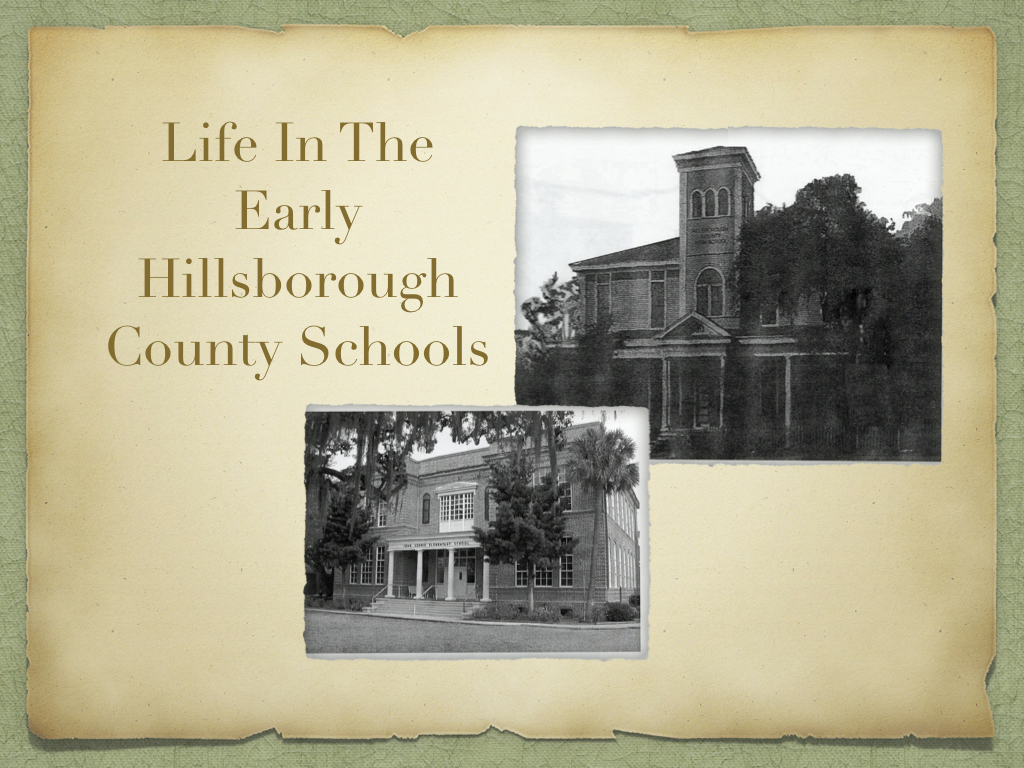
In the mid to late 1800’s, most of Hillsborough County was rural and agricultural. It covered a vast area and small, scattered settlements gradually developed throughout the county. Due to the distance between these settlements and the primitive transportation of the times, many of these settlements founded their own rural schools. When the school’s enrollment reached ten, the neighborhood then petitioned the Board of Education to have its school sanctioned as a “public school”. Although the Board typically did not assist with the construction or furnishing of these schools, they did pay teacher salaries. There were reports of the Board paying for improvements such as adding a wood stove for heat. Paul Dennis, public Information Officer for Hillsborough County Schools in 1975, referred to these rural schools as “neighborhood schools” in his report, “The Neighborhood Origins of Public Schools in Hillsborough County.” 1871-1900. (9)
These neighborhood schools were best described as small, one-room buildings without windows. Most were log-cabin structures. In 1951, the Historical Commission published an interview conducted by Mrs. Agnes Worthington with Mr. Henry Seiner. It provides a glimpse of the typical, early rural school. Mr. Seiner was a member of the first family that moved into the Ruskin (Little Manatee) area in the 1860’s. He probably attended school in the late 1860’s and early 1870’s. Mr. Seiner reported,
“Throughout the school terms, school was held in a small log building about eighteen by twenty feet. There was no means of providing heat and no windows; a door was located at each end. The logs were spaced some distance apart and the children suffered as the chilly winter winds whistled through the building, church services were conducted in the little log school building by a Reverend Robinson who lived in Gillett.” (30)
One of the earliest neighborhood, rural schools recorded in the Board of Education minutes was the Spring Head School #31 located southeast of the Plant City area. Although the school was not mentioned in the Board minutes until 1876, it is believed that settler George Hamilton established a private school years earlier at the site. “Plant City: Its Origins and History” provides some interesting information about how this school was founded. It represents the spirit that existed in the Plant City area in the early l860’s and the high priority the area placed on educating its children. The story was retold by Omar Mitchell, great-grandson of George Hamilton. Mitchell recounted the family legend of how his great grandfather founded the early school at Springhead.
“George Hamilton placed a high value on education and wanted his children to have the benefit of schooling. He was pleased when a man rode up on horseback one day in the early sixties and announced that he was a teacher. Mr. Hamilton handed the man a Bible and asked him to read several passages. Then he handed him a quill asking him to copy a verse or two. Satisfied with the man’s apparent qualifications, he instructed his servants to clean and prepare a small hut on the premises for a classroom. He then saddled his horse and hurried off to invite neighbors to take advantage of this educational opportunity for their children.” (4).
Schools were not a high priority in many areas of Florida during the mid l800’s. Early pioneer families were so busy settling themselves and dealing with hostile Indians, that few efforts were made to establish schools. According to Norma Frazier (30), the first school that was open to the public was founded in Key West in 1834. Although some attempts were made to establish public schools in the early 1840’s, these attempts were not successful. By 1849, Franklin and Monroe were the only counties in Florida to have true public schools. A schools did develop in Hillsborough and other counties, many originated in neighborhoods, founded by residents of the neighborhood. This was the case throughout Hillsborough County between 1850 and 1900. During the first 50 years, as small rural schools were founded throughout Hillsborough County and Florida, the residents in the neighborhood typically provided much of the furniture for their school. James Covington reported an interview with a young girl from the Whidden family who attended rural schools in Hillsborough County in the late1860’s. (32) The girl recounted”
“The neighbors lived close together and would join in and hire a teacher. My first teacher was an old man named Davis. He taught school in my grandfather Howard’s barn. The men made benches and put them along the sides of the wall. They were split logs smoothed off with a plane, with wooden legs pegged into them. A few had pencils and paper but paper was scarce.
When a child got a sheet of writing paper, he thought he had something wonderful.” The interview continued, “At my school, the big boys and girls had slates. We little ones had the Blue Backed Speller.
My third school was taught by Miss Lizzie Beny. It was called Taylor School. The other children were the Taylors, Knights, Wingates, Stevens, Harris’, and Pitts. I had a pencil and paper. I don’t remember any blackboard in this school.” This is interesting because Taylor’s School was cited by Paul Denis in “The Neighborhood Origins of Public Schools in Hillsborough County” as School #9 first mentioned in the Board minutes in 1872. (9)
“We carried our dinners in tin buckets, (if we could get buckets). Some of us had home-made baskets of strips of inner bark of certain trees. Our dinner consisted of cornbread, rice or grits, and meat of some kind. Sometimes we had biscuits, but flour wasn’t as plentiful as cornmeal. One of the best things we had was sweet potato pone. It was made of grated sweet potatoes, eggs, and spice, and was sweetened with homemade sugar.” Of course , the social lives of students were very different in these old rural schools. Covington’s interview continued with a glimpse of this.
“We had to walk five miles to Miss Berry’s (Taylor School). We took a path through the woods and we often saw wolves and wildcats, but they never bothered us and we were not afraid. A big girl named Adaline Pitts came home with us sometimes. She would talk and laugh with us and tell us stories, and we loved for her to go home with us to stay all night. Then we would have her to go along with us back to school the next morning.
“At recess, we played ball and Three Old Cats. Sometimes the boys played Bull Pen. Boys and girls did not play together. We girls played such games as Poison Stick, and Wood Tag. I was almost grown before we learned to play Handkerchief and Go In and Out the Windows. Singing games like ‘Skip to My Lou’ came in at about that time. We had recitations on Friday afternoons. Some of the neighbors would come and would sing songs, too.”
These primitive, neighborhood schools in the rural areas rarely had heat and were often constructed without windows. Mrs. Emma Gaylord provided the following descriptions in “Life in Florida since 1886”. As a young child, Mrs. Gaylord attended Hillsborough County Public Schools in the 1890’s. The Lake Thonotosassa area that Mrs. Gaylord referred to was inhabited by Indian tribes that were sometimes hostile only 30 years before the time of her quote. In Robinson’s “History of Hillsborough County Florida” in 1928, (1) it was reported that settlers fought off Indian attacks as late as the post-Civil War years. In regard to her school experiences in Hillsborough County Schools, Mrs. Gaylord reported her experiences as follows.
“The first term of school I attended was at Lake Thonotosassa in the neat board and batten building. I can recall the names of only fifteen pupils. The next school was called Magnolia. It was a poorly constructed little building, with spaces between the crooked logs wide enough to stick a hand through anywhere, a head in many places. The term began in September and ran four months. When it got too cold, we went to a bonfire outside. The next year, four paned windows, about two feet square had been set in the north and east walls, and a heater stove put in. Each father made a desk for his own children according to his own ideas. Ours seated the three of us (my two sisters and me). Drinking water was brought from a nearby farm well, in a cedar bucket with brass hoops.”
Mrs. Gaylord had very fond memories of her teachers (Mr. Clendenning and Miss Easton) who prepared her well to attend the high school in Tampa.(16)